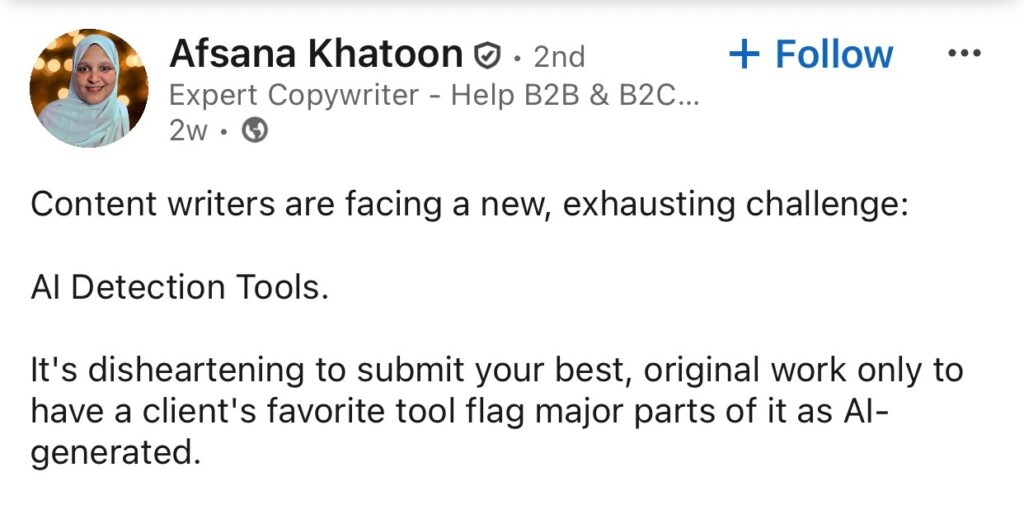
There’s an ongoing feud between writers and clients over AI-generated content. Many writers now prefer to outsource their creative tasks to LLMs, and clients are turning to AI detection tools to sniff them out.
The crazy part is that innocent writers get caught in the crossfire because most of these AI detection tools are unreliable.
Source: LinkedIn
As much as I sympathize with writers like Afsana, clients’ concerns about AI-generated writing are valid.
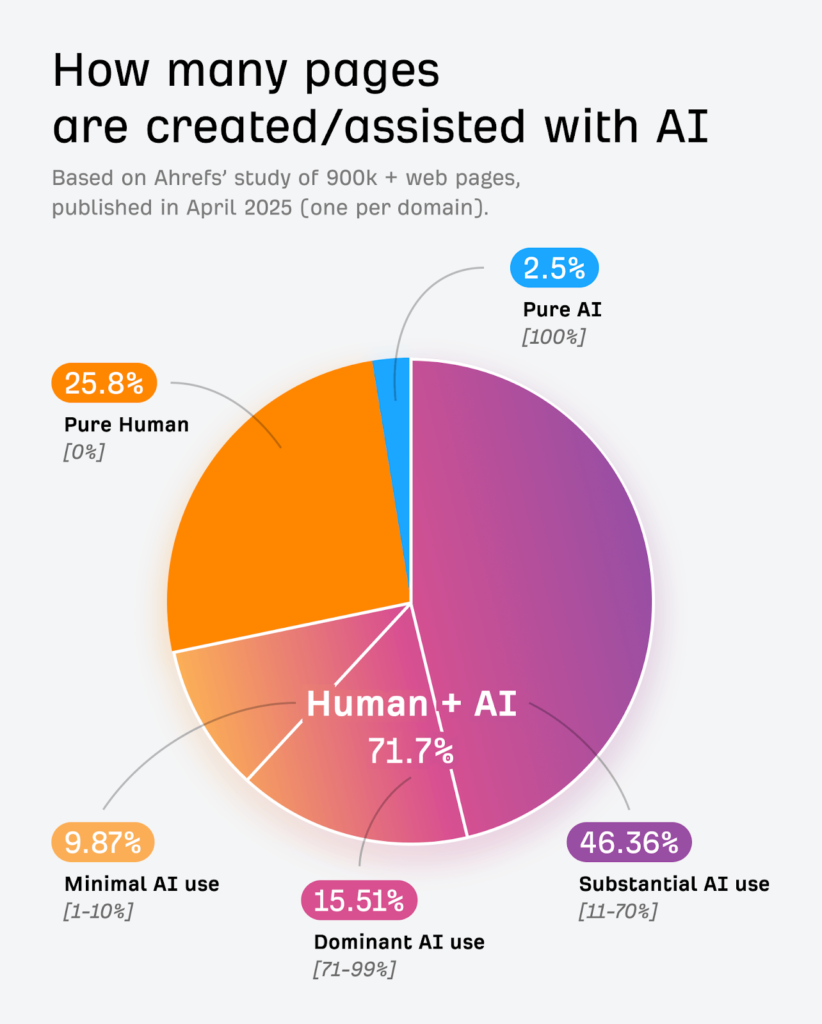
A study by Ahrefs that analyzed 900,000 newly created web pages in April 2025 shows that 74.2% of them contain AI-generated content.
Source: Ahrefs
Out of these, 2.5% (22,500) of the domains used copy-paste AI writing. A clear indication of how deep over-reliance on AI has eaten into the writing industry.
In my opinion, AI should only be used to cut down time spent on research and for refining original ideas. It should NOT be used in the content creation process.
I’m certainly not the only one who feels this way; writers like Robert Biswas-Deiner strongly agree. He argues that AI should be used like a colleague to flesh out ideas, find unique content angles, and locate research sources.
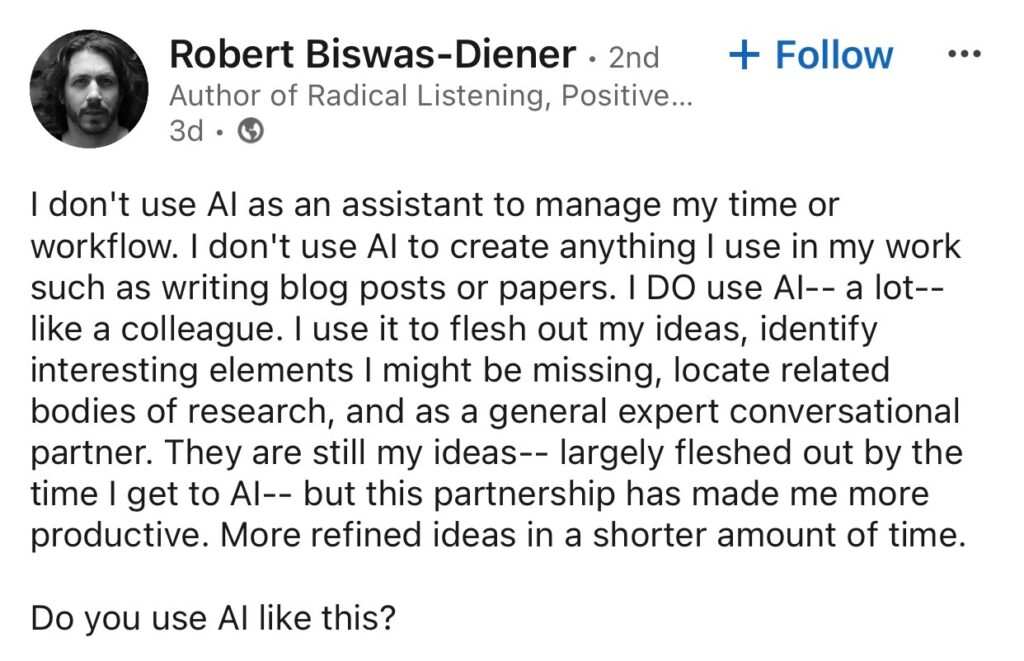
Source: LinkedIn
Writing isn’t the only thing that’s seeing an increase in AI usage. The way people search for information also is.
According to HigherVisibility, 83.7% of 1,500 Americans surveyed reported using AI tools for search. The same report mentions that Google’s share of general information searches dropped from 73% to 66.9% in six months.
These stats show that search is evolving. More and more people are turning to AI-powered generative engines for answers to queries they would have typed into Google five years ago.
So what is this new era of search, and what metrics should content marketers care about?
What Exactly Is the GEO Era?
Generative Engine Optimization (GEO) is the process of structuring a brand’s online presence to increase the likelihood of being mentioned or cited by Large Language Models (LLMs) like ChatGPT and Claude.
A mention is when an AI model talks about a brand or product by name in response to a query without including a link. On the other hand, a citation is when it provides a link to a piece of content as a source of information.
AI mentions and citations have become important metrics for founders and marketers who want visibility as search behavior shifts from traditional to AI-powered search, aka the GEO era.
From SEO to GEO — The New Discovery Model
Both SEO and GEO share the same goal: to provide users with the most appropriate answer to a query. However, they differ in how they fulfill that goal.
Search engines primarily rely on content structure, keyword optimization, and backlinks to determine how a piece of content ranks on search engine results pages (SERPs) for related keywords.
In contrast, AI models use training data to establish connections between entities and how consistently they appear across multiple touchpoints related to a topic.
This means that third-party mentions on review sites, industry blogs, and even social media influence how and where brands appear in AI responses, even if these mentions don’t include a backlink.
| SEO | GEO |
| Focuses on improving rankings in search engines | Prioritizes getting featured in AI mentions and citations |
| Dependent on keywords, backlinks, and topical authority | Relies on brand mentions across multiple touch points |
| Impact is measured by click-through rate, time on page, and bounce rate | Visibility in AI responses is the key performance metric |
How Generative Engines Decide What to Mention
Generative engines decide what to mention based on a combination of factors such as learned patterns, contextual relationships, and recency.
If a brand frequently appears alongside a topic—like Semrush and SEO—generative engines learn to associate the brand with that topic through statistical patterns in training data.
Context also matters. If a query is generic, most models tend to default to safe, well-known brands that appear more frequently in their training data.
But if it contains a specific brand, the engine uses that as a cue.
With subjective queries like “Best product for X,” generative engines usually avoid brand-owned assets in favor of third-party domains to maintain neutrality and provide credible information.
Based on the data from Semrush’s study, Reddit, LinkedIn, and Wikipedia are the top-cited domains across ChatGPT, Google AI Mode, and Perplexity as of October 2025.
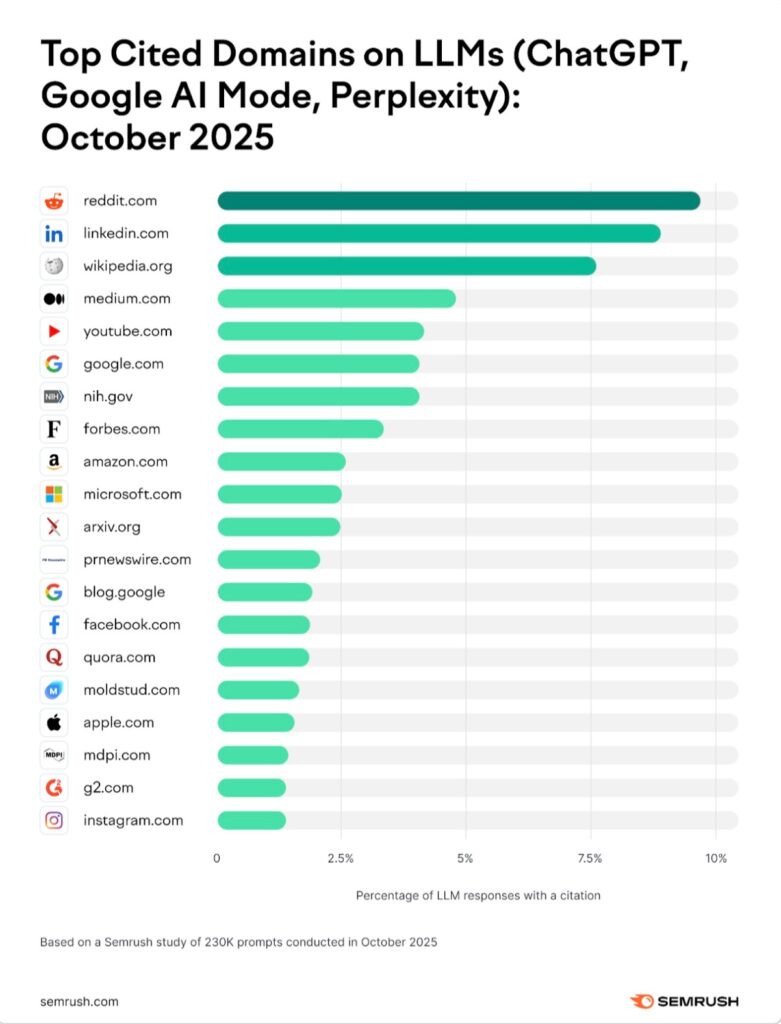
Source: Semrush
LLMs also prioritize fresh content in time-sensitive queries. Models like ChatGPT use a web search tool, which is a form of Retrieval-Augmented Generation (RAG) to access current information beyond their training data.
When I asked ChatGPT about the “Latest crypto news,” it was able to provide up-to-date feedback. Most of the articles it cited were published recently—a few days old at most.

Source: ChatGPT

Source: ChatGPT
I tried a second prompt: “Latest skincare trends for 2025.” Unsurprisingly, the output was similar to the first in terms of recency.
The only difference was that it brought up articles that were a few weeks to several months old. This change is understandable because skincare trends are not as volatile as the crypto market.
| Pro Tip 💡 One way to optimize content for recency without re-writing the entire article is to update the data or stats. |
What Influences LLM Mentions and Citations
You’re mistaken if you think generative engines mention or cite brands randomly. Their choices follow a structured process that ensures answers match search intent and are as accurate as possible.
These three key metrics influence what appears in LLM responses:
E-E-A-T signals
E-E-A-T is an acronym for:
- Experience: First-hand experience or practical knowledge of the topic
- Expertise: In-depth knowledge about the subject matter
- Authority: The reputation of the author of the content
- Trustworthiness: Reliability and accuracy of the content and brand
It’s a framework developed by Google to help human reviewers access content quality and brand authority. Sites with strong E-E-A-T signals often rank higher in search results.
While ranking high in Google’s SERPs doesn’t guarantee AI mentions or citations, it definitely helps.
According to results from the Freelance Coalition for Developing Countries’ (FCDC) October 2025 study, 58% of brands that consistently rank on page one (positions 1-10) also appear in AI answers.
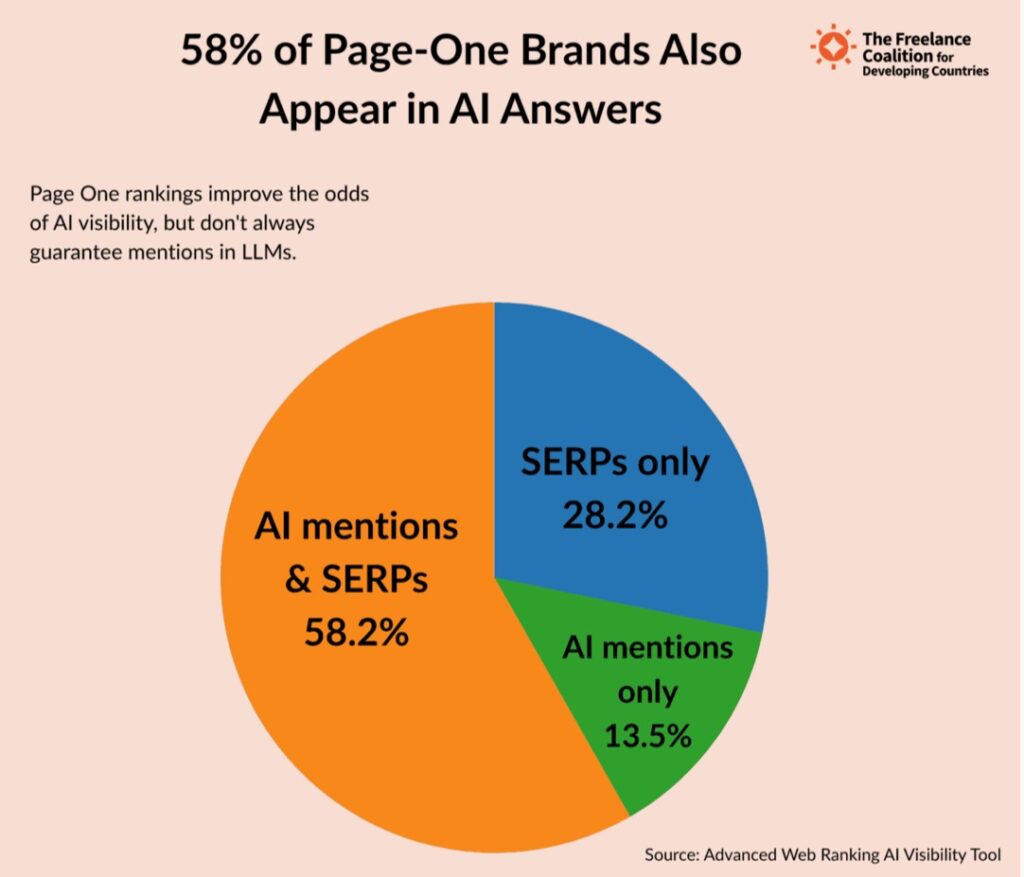
Source: FCDC
This data indicates a strong overlap between SERPs and LLM visibility.
So, if you’re in the “SEO is dead” camp, better think again. Fixing your brand’s SEO is non-negotiable if you want visibility in LLMs.
But as I explained earlier, generative engines don’t just rely on search results. They associate entities with data from multiple touchpoints, which influences the brands they mention or cite.
As Chima, Senior Content Marketing Manager at Moz, rightly puts it, featuring in LLM responses requires a holistic approach that includes:
- SEO for discoverability
- Digital PR for credibility
- Influencer marketing for trust
- Affiliate marketing for demand
- Social media to stay top of mind
All these strategies work together to improve brand visibility. Better visibility = more mentions and citations in LLMs.
Content structure
I always say that content structure is just as important as the content itself. Search engines and AI crawlers alike rely on clear structuring to understand the content on a webpage.
| Pro Tip 💡 Don’t hide valuable content behind login pages or paywalls because AI bots cannot bypass these restrictions. |
Proper heading tags are a crucial foundation. H1, H2, and H3 tags differentiate the primary topic and subtopics and help AI systems understand the content hierarchy.
Utilize answer capsules (concise answers to question-based queries) to improve your chances of getting cited for related queries.
Ideally, an answer capsule should be directly under a heading and contain not more than 25 words.
Evidence suggests that answer capsules strongly influence LLM citations. Especially when they don’t contain any internal or external links.
Present high-value information as lists. It makes it easier for LLMs to quickly pull relevant snippets in response to queries.
Ensure that you use proper tags for each list: <ol> for ordered lists and <ul> for unordered lists.
And of course, good ol’ schema markups are equally important. They provide context that HTML tags alone can’t.
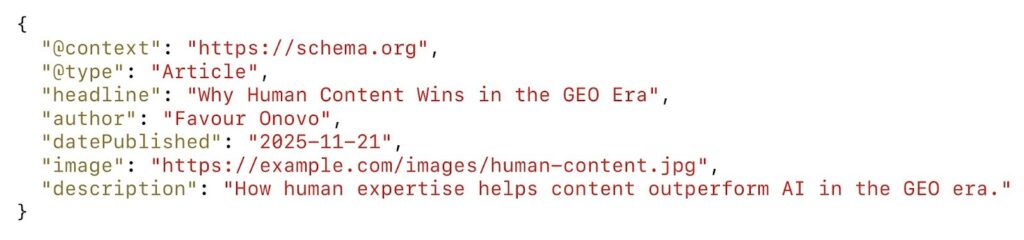
Source: ChatGPT
Article schema, which is the most common type, helps AI bots understand the core details of a written piece like headline, author, and publish date.
Other common types of schema markup are:
- FAQ schema: Highlights questions and specific answers
- Product schema: Provides structured information about a product
- Review schema: Tells AI crawlers that your content contains reviews
- Breadcrumb schema: Shows how each page fits into the overall website hierarchy
Recency and freshness
Believe it or not, LLMs show strong content recency bias. Enough bias for recency to be a key metric that influences AI visibility.
Source: Seer Interactive
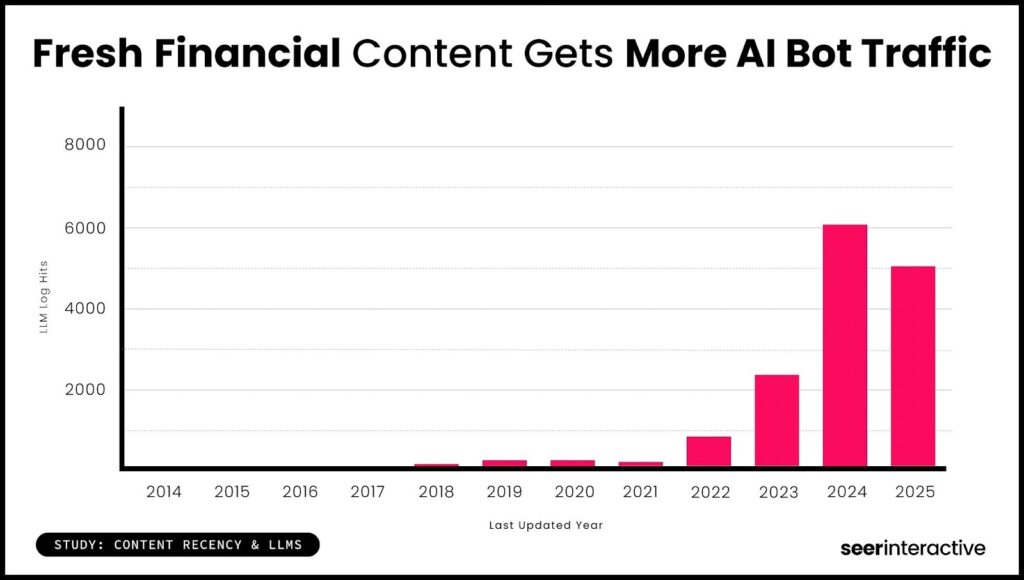
An analysis of 5,000+ URLs with extractable publish dates by Seer Interactive shows that ChatGPT, Perplexity, and Google’s AI Overviews prefer to cite content published in the last five years 94% of the time.
However, the level of bias varied across industries.
Source: Seer Interactive
For example, in the financial services industry, where information quickly becomes obsolete, content published between 2023 and 2025 accounted for over 90% of AI crawls.
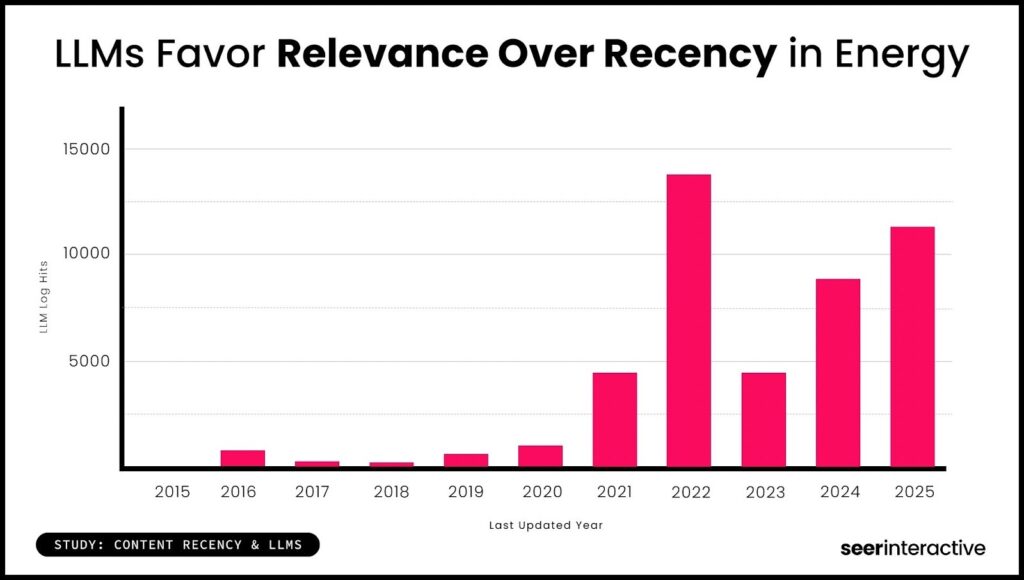
In comparison, content in the energy space fared better in terms of longevity due to its mostly evergreen, educational nature.
Although over 80% of bot visits still went to content published after 2020, information resources published as far back as 2016 were still being crawled by AI bots.
Source: Seer Interactive
The bottom line? Recency matters, and it always has, even before GEO became a thing.
Freshness and relevance also carry weight, especially in industries like energy, where there are a lot of evergreen topics.
If you haven’t already, this is your wake-up call to finally update those outdated pages with fresh, relevant information.
While you’re at it, don’t forget to add publish or update dates using article schema markup.
Why Human Expertise Still Wins in the GEO Era
AI-generated writing is getting better as LLMs become smarter. But it’s still plagued by several problems that make it subpar to human-written content—for now and in the foreseeable future.
The main danger of using AI to write is that you end up sounding like everyone else. Because your competitors are likely using the same tools and similar prompts.
Again, SEO and GEO significantly overlap. Google’s E-E-A-T framework rewards unique expert content based on first-hand experience.
LLMs have neither expertise nor genuine experience. They can only try to imitate these qualities.
To make things worse, even the best LLMs frequently provide inaccurate information disguised as facts. A phenomenon known as hallucination.
These hallucinations can cost you your reputation, like it almost did to Deloitte in a case with the Australian government, where a report prepared by the company was found to contain suspected AI errors.
You could even get sued if the false information you put out courtesy of LLMs endangers people’s lives or breaches regulations in your industry.
Is this the kind of system you really want to outsource your writing to? I don’t think so. The risks far outweigh any benefits.
The Human Edge
Human writers have the ability to inject perspective, emotion, and cultural nuance into content. These are elements of good writing that I’ve seen LLMs struggle to recreate without much success.
Perspective
Content creation has since moved beyond just writing. It requires a contextual understanding of business needs and how each piece of content fits into the bigger picture.
Emotion
Type in a prompt. Copy and paste. Hit publish. That’s how you end up with emotionless content no one wants to read. Your site’s bounce rate skyrockets, and rankings drop. Then you wonder why you’re invisible in AI responses.
Only humans truly understand what makes other humans tick and how to create content with emotional depth.
Cultural nuance
If you’re writing for a niche audience in a specific location, AI output will almost certainly disappoint you. Generative engines can’t understand cultural nuances like language and humor the way a human from that region does.
The Kind of Human Content AI Loves to Cite
To gain AI citations, these are the types of content you should be investing in:
Comprehensive Comparison Guides
Detailed, user-focused comparison guides that answer the burning questions your potential or existing customers have are critical for getting cited by LLMs.
But the interesting thing is that, depending on your industry, LLMs may avoid citing this type of content when it appears on your own blog rather than a third-party site.
Source: Search Engine Land
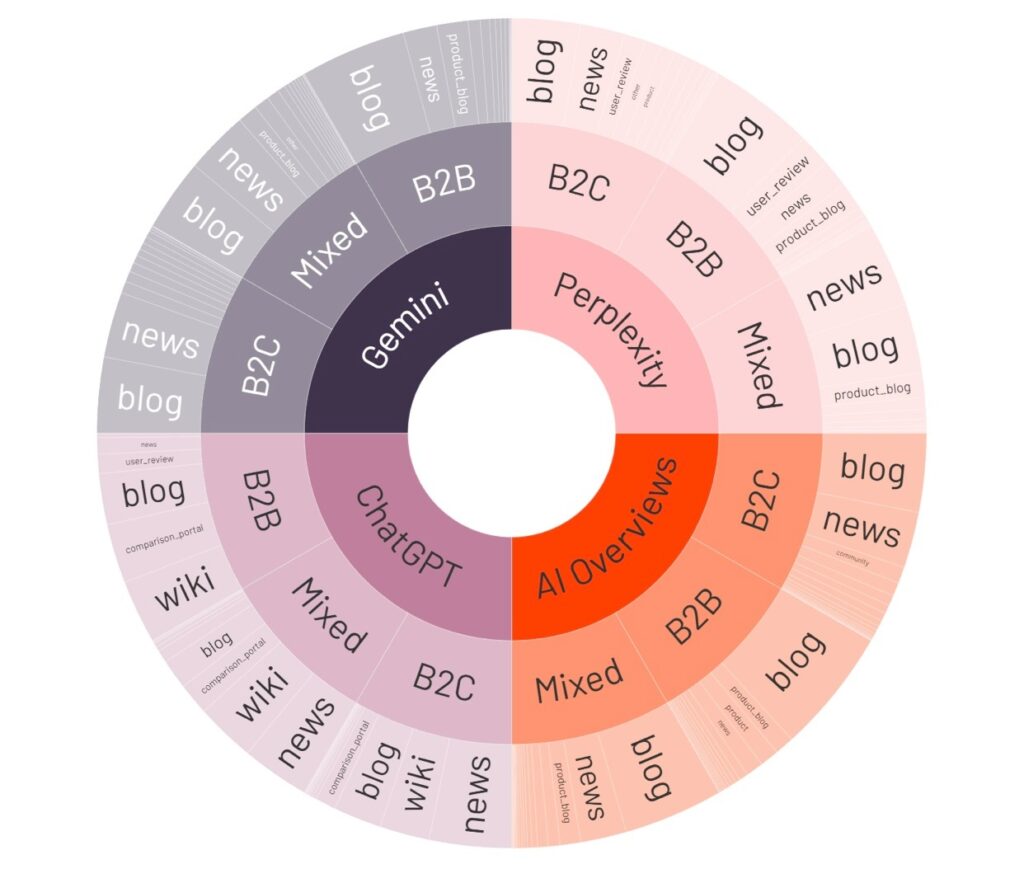
Search Engine Land’s May 2025 study reports that, for B2C queries like “best smartphone brands,” LLMs lean heavily toward perceived neutral sources such as review sites, mainstream news outlets, and user-generated content in online communities like Reddit and Quora.
In B2B queries (e.g., “best CRM software”), brand-owned assets, such as product blogs, performed better. They accounted for 17% of citations.
So, what does this mean? Your guess is as good as mine.
If you’re in the B2C industry, you should focus on getting featured in top industry publications and building a strong online presence overall.
On the flip side, B2B brands must prioritize creating high-quality, informative listicle-style comparison blog posts that subtly highlight why they’re better than the competition.
Original Research and Insights
LLMs cannot invent data. They rely on the data they’re trained on and what they can access through RAG to generate responses.
What this means is that original research data, such as survey reports, will continue to feature heavily in LLM responses.
An audit by Search Engine Land supports this claim. 52.2% of cited blogs from 15 audited domains featured either original data or brand-owned insight.
Original or brand-owned insight simply means giving your perspective based on already existing information.
Subtle changes in how you convey information can influence how LLMs like ChatGPT interpret your content. You can turn generic advice into a personal insight that showcases experience and expertise.
| Pro Tip 💡 For example, instead of writing: “Apps like Forest remind you to take short breaks throughout the workday to prevent burnout.” Write this: “I observe a significant boost in performance when I use the Forest app to schedule short breaks throughout my workday.” |
Step-by-Step Frameworks
From basic tasks like cooking to troubleshooting a complex software problem, people use LLMs for diverse purposes that require a step-by-step process.
For queries where recency is not a major concern, ChatGPT tends to pull information from its training data without attribution.
This is in stark contrast with what I have observed with Google’s Gemini, which relies heavily on SERPs.
Source: ChatGPT
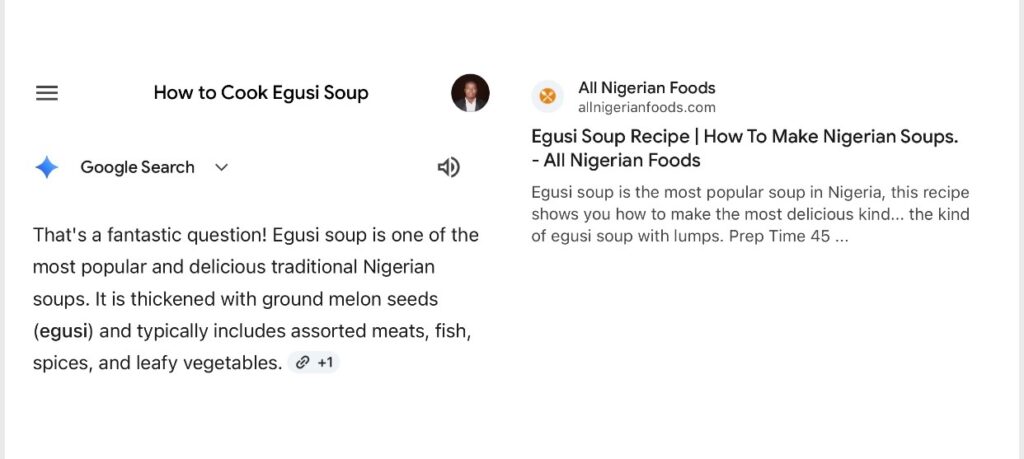
Source: Gemini
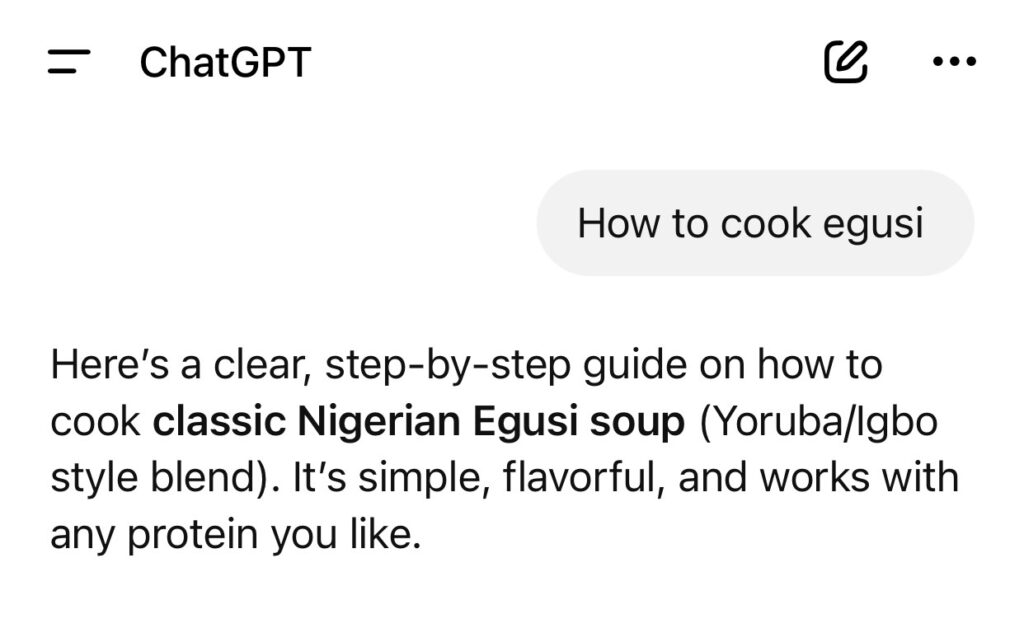
I asked ChatGPT and Gemini, “How to cook Egusi soup,” a local Nigerian delicacy. ChatGPT’s output had no citations while Gemini cited six sources.
Of the six, five ranked in positions 1-10 on Google; this further underscores the importance of solid SEO as a foundation for GEO efforts.
People will always search for how-to guides. It’s your responsibility to ensure you’re there with the right information to help your brand get seen.
Expert Interviews
Conducting and publishing expert interviews is a great way to boost E-E-A-T signals and secure LLM citations.
Why? Because expert interviews contain fresh information that doesn’t exist anywhere else on the internet. Plus, they come from credible sources and are often based on lived experiences.
Aside from increasing your E-E-A-T signals, this type of content can also help you earn backlinks when others reference your content as a source. Especially if the interview covers a trending topic in your industry.
Backlinks are still an important ranking factor for SEO. I’m sure you already know where I’m going with this, but I’ll say it again just in case.
Strong SEO = Solid base for GEO.
Source: Smarketers Hub
So, when next you’re thinking of content formats to publish to move beyond the generic cookie-cutter content that LLMs now avoid, consider expert interviews.
The Skills Writers Need for the GEO Landscape
There’s no doubt in my mind that human writers are going to win in the GEO era.
But to win, you must evolve. Knowing how to write is no longer enough. Of course, it’s a great start, but there are other skills you need to stay afloat.
Strategic Positioning
You need strategy; lots of it. Thankfully, you don’t have to reinvent the wheel. You just need to ask the right questions.
What are your competitors doing? Is it working? If yes, how can you refine it and make it better to stand out? These questions should guide your content efforts.
However, strategic positioning is much more than mirroring what the competition is doing.
You need to infuse your writing with actual research insights from real customers. Check out Reddit, G2, and other review sites to find out what customers are saying about your brand or product.
By integrating user-generated feedback into your content and transparently discussing pros and trade-offs, you create the kind of balanced content LLMs love to cite.
Data Storytelling
Data storytelling involves building a narrative around data to explain what happened, why it happened, and propose a way forward.
Good data storytelling has three components:
- Data: The raw numbers and statistics
- Visuals: Charts, graphs, and other visual aids
- Narrative: The context and explanation that connects data to a conclusion or call to action
It’s even better when your storytelling is built around proprietary data. If your content is the only source reporting a statistic, it becomes the de facto source for that specific data point.
Remember to use text to explain information contained in images because AI crawlers can’t read charts or other visual data representations.
Multiformat Awareness
Don’t rely on a single type of content format. You need to understand how to create content that resonates across multiple platforms.
Think scripts for video, podcasts, and social media content.
The more places your brand appears, the better your chances of getting cited by LLMs. We’ve already talked about how LLMs rely on multiple touch points.
Brands like HubSpot and Coursera that combine multiple content formats perform very well in AI-generated responses.
YouTube, LinkedIn, Facebook, and Instagram are among the top cited domains by LLMs.
The Road Ahead — Verified Humanity
As AI writing becomes more human-like, writers need to focus on being verifiable.
This means prioritizing authenticity, authorship, and showcasing real expertise with each piece of content.
If you want to future-proof your content for the GEO era, start by creating the kind of content only you can—human-first, research-backed, and impossible to fake.
Then ensure your messaging and branding are consistent across relevant channels for LLM mentions. If you’d like to learn more about how to stay ahead as the human vs machine battle intensifies, you can connect with me on LinkedIn.